A circle banner - and Einstein's new look

"I think Einstein probably wore a chain," my student said as she proudly decorated her circle banner. I love the creativity!


My students had a great time with this activity.


I used it as kinda an exit ticket for our lesson on circles, with each student getting a different problem. It was easy to differentiate with the variety of complexity of the problems. Some students solved for circumference given radius of diameter and some found the circumference given the area. Several got very excited to decorate their banner piece, then we voted on a winner, and everyone hung it on the class banner.

I am so excited to try out the Algebra ones as an end of the year review project. I can't believe we still have four weeks of school left 😜 

Making Notes FUN!

I am slightly obsessed with this new resource I found on Pinterest called Doodle Notes. I was immediately intrigued by the colorfulness of the notes and purchased a few from TpT to try out in my classroom. My students loved them as much as I did ...


These doodle notes fulfill two of my main objectives for interactive notebook: active engagement and having a valuable reference resource.  I love to see students taking pride in their work , which has been my focus with interactive notebooking this year. Earlier in the school year, an assistant principal came into my class for an informal observation and one of my students asked him, "Do you want to see my notebook?" He commented on that during my follow-up conference because it was the first time it had happened to him. I love that students are so proud of their notes that they want to show them off!

I also love to see students engaged - even if it means coloring, because they are much more likely to remember these notes than any that they copied down on notebook paper.

Taking inspiration from these Doodle Notes, I've tried to make my daily notes more engaging. It's amazing how adding some clip art, a fun font or giving students an area to color or personalize their notes helps with engagement.

I saw so many students coloring this Ferris Wheel as they read through the problem, while they were creating a strategy, or when they finished.


This clip art helped a few students remember this "trick" for turning rational exponents into radicals.


I created my own version of interactive notes for introducing Polynomials. It gives students a few places to add color and personalize their notes. Check it out for free in my TpT store.


Show Your Thinking - and Every Step


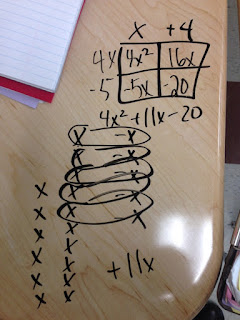
This year I tried to focus on making math make sense. My students still struggle with integer rules and it really showed when we were multiplying polynomials. I loved the box method for both multiplying and factoring, and using the same technique for both reinforced the ways the two operations are connected. I like the organization of multiplying with the box because it insures each term is multiplied by each term, without anyone being left out. When it came to combining like terms, some students struggled with the integer operations. I resorted to my middle school tool box and pulled out the idea of zero pairs. This helped students have a concrete method to use while they formulated their own algorithms. 

Writing with dry erase markers on the desk somehow always gets students to show more work. They are much more willing to take risks in this medium than with pencil and paper, plus it's different than all their other classes. Anything to keep them engaged 👍🏻


Radicals

I was determined not to teach student a "trick" for simplifying radicals. I have heard so many cute explanations, like "needing a partner to get out of the house," but after reading "Nix the Tricks," I realized teaching only a trick robs students of the math behind what they are doing. We are down to a single-digit countdown before the EOC, so my lessons are hurried. I taught simplifying radicals, gave students a couple practice problems that we worked out together and then gave them an exit ticket. I was feeling good about my lesson. Then I saw the Exit Tickets. Yikes! I'm not sure if it was no enough time for them to complete the exit ticket (sometimes I misjudge their pace on new content) or the lack of practice, but overall the scores were terrible. With only a few days left until the EOC, I had to make a decision to cut my losses or spend another day on the topic. I decided if they can do anything with radicals, it should be simplify them, so we stopped and reviewed. We completed a Warm Up, and then reviewed the Exit Ticket. I love the all-or-nothing grading system here because if students didn't get it 100% correct, they don't know where they made the mistake, so they have to go back through their work with a fine-tooth comb to find their error. These select-all-that-apply questions have become my favorite way of questioning.

After we revised the exit tickets, I presented my favorite means of practice - a Tarsia Puzzle. Students had to be careful to "attend to precision" because several of the problems and answer choices were similar. This forced students to really focus on their exponents and see the difference between having x^3 inside a radical and x^4. It also meant that students didn't have to keep re-creating a factor tree for each problem. I heard great discussions about what happens when the radical has a coefficient in front of it too.


I made sure students had plenty of time to work on their exit tickets - another select all that apply question. The results were SO much better than the first day! If I could do a back-flip - I would. I saw several 100%s and so much more confidence from my students, which is exactly what I want as we approach testing season.

Check out my product in my TpT store if you want to try this fun way to practice simplifying radicals.

Laws of Exponents Puzzle


I recently discovered Tarsia Puzzles and they are my new favorite go-to activity for practicing math problems. In this lesson, I used them to practicing power to a power, product rule, and quotient rule for exponents. The students had to correctly work out 30 problems to piece the puzzle together and they had way more fun practicing this way than a worksheet. I overheard some great discussions about the rules and misconceptions (which they can self-identify when they don't find the answer they are looking for).


Here is the link to my TpT store, where for $3, you can buy the Laws of Exponents puzzle.


Learn your multiplication facts

Multiplication facts are one of the most essential tools students need to go forward in math. I am always shocked by how many don't know them - even now in dealing with high schoolers. They used to simply turn to their calculator, but with the changes in common core, students can no longer rely on that tool. Even though understanding when and how to use mathematical tools correctly is one of the mathematical practices, the Algebra EOC has a no-calculator section. Included in this part of the test are questions about operations on polynomials, solving quadratics by factoring, and simplifying radicals - all these skills depend on students knowing their multiplication tables. I created this Tarsia puzzle for a conference presentation for elementary school teachers, but it is actually fun for my high school students too. I use it when I have students who need to fill a few extra minutes or to have a race and see which group can put the puzzle together first. Maybe someday I will have students who have times tables on automatic recall. Until then, practice makes perfect. Pick up a copy to use in your classroom at my TpT store here


Coloring in High School

I love to have self-checking activities in my classroom. Although students can easily check their work when solving equations, few of them do. I find that if I offer an answer bank they will take more time attending to precision in their work. With this activity, I combined my love of answer banks and coloring into a fun activity. My students needed to practice solving equations with variables on both sides and using their prior knowledge of distributive property and combining like terms, but I needed something more fun than a traditional worksheet to hold their attention. So I created a coloring answer bank.
High schoolers are really just big kids so they loved this activity. I loved hearing them say, well I got 15, but that's not an answer choice, so I much have made a mistake. I also gave them the hint that no adjacent shapes would be the same color, so they had another opportunity for self-checking. Check out this activity in my TpT store for $2.

The other activity I use each year and love is the Solving Equations flower - perfect for the easier two-step equations.

Check out this activity in my TpT store for $2. 

Happy coloring!
Related Posts Plugin for WordPress, Blogger...