Para-bowl-as!

Why is it that so many students insist on pronouncing parabolas as "para-bowl-as"!? I was really excited to jump right in to discovering how factoring ties to parabolas and their graphs, but my students needed some basic vocabulary and graphing practice first. I jogged their memory of input-output table and graphing with a Warm Up of a linear function, then we jumped right into parabolas.
This summer, I made these cool doodle notes about graphing quadratics. {It's always exciting when I get to finally use something that I worked so hard on!} This lesson last year took WAY too long, so I expedited things by giving students an partially filled in input-output table and the parent graph. 

For each section, I would fill in the first row of each input-output table and then set students loose. I would invite one of my early-finishers to graph the parabola on the board, then I would have the students generalize the rule at their tables. Then I would ask them similar questions like : where would the vertex of x^2 +100 be? What about x^2 - 25? Which graph would be wider y = 10x^2 or y =1/4x^2? My students got it - I really liked how they could compare to the parent graph for each one.

I loved watching students make connections as they created their graphs. and how they discovered how changing part of the equation changed the parabola. They also quickly noticed that the output values repeat once they find the vertex.


Then to practice even more, I used this Graphing Quadratics Station Activity from All Things Algebra to continue graphing parabola. I did not have them move around to stations though. We did Graph A together, so that I could review all that fun vocabulary we just learned and remind them about domain and range. The students were in pairs, so they played rock-paper-scissors to see who had to pick up their first card from the back table. I printed the answer key and stapled it to the back of the card. I made sure to emphasize that students who were caught copying would NOT get any points. But I actually loved having the students have the answer key so they could self-check as they went. I heard great questions from my students, like "How did they get this answer?" Or "I see my mistake." I caught only a handful of students copying out of all 140 of my Algebra students, so I was really impressed. Plus my students felt confident in their graphing skills when they could check-in as they went without constantly calling me over to verify their work. When they finished a card, they would do another round of Rock-Paper-Scissors and then head to the back table to swap out the card. 

About 5 minutes before the end of class, I had students draw a large star next to an empty graph spot and complete an exit ticket problem. After class, I sorted them into students who got everything in the problem correct and students that missed part of it. During the next class, I had those with perfect papers help their peers make corrections. I love this quick remediation and empowering my students to teach others.
Next up, we learned how to use the x-intercepts to match equations to their graphs and applies those factoring skills. Check out that lesson here.

Best PD EVER!


This week I had a unique opportunity to observe a superstar teacher in my district. She teaches at a nearby high school, but her school has had amazing results in getting kids to pass the Algebra 1 End of Course Exam (FSA), and she has been leading the pack. I've heard great things about her class so when my AP asked if I wanted to spend the morning there, I jumped at the chance! In nine years of teaching I have been to countless hours of professional development, but this was definitely the most helpful and relevant. I love that I am part of a community of educators who love watching students succeed so much they are willing to take their time to share their best practices, and lifelong learners willing to constantly refine their craft until they find what works best for the students.

It was such a reflective experience to watch someone else teach. She did an amazing job providing real-time remediation to her students via peer tutoring and also spiraling review throughout her warm ups and exit tickets. In the prior class, students completed this exit ticket and then she used it to create groupings for the next class.

I do a lot of group learning and always encourage students to ask their peers for help, but she had a very intentional method of doing this that I am definitely going to use. She had a quick meeting with her peer tutors and each of the three students was assigned two students to help. The two students in each group who were receiving tutoring reworked exit ticket problems on the window (I never thought to use dry-erase markers there!) and then wrote out how to solve it and the steps in words for solving. They they repeated the process with another problem. This helps address misconceptions before they get out of hand. While these students were doing the tutoring cycle, the rest of the class started on the classwork assignment, and she floated around answering questions. As the tutoring groups finished, they started in on the classwork assignment.  I think I sometimes get worried about what it will look like when everyone isn't working on the same thing, but visiting this class showed me that once the students are trained with your expectations, the process can unfold pretty seamlessly.


The next day, I tried it in my classroom. I had students complete a graphing quadratics problem as an exit ticket and then quickly sorted them into students who got it 100% correct and students who missed part of it. I had a few students who messed up completely, and they were the ones I targeted. During the next class, I passed the papers back and the students with stars circulated and helped their peers as the others reworked the problem. I have a ways to go before it unfolds as perfectly as what I saw, but I loved how my students received feedback and had an opportunity for revision. I also loved how empowered the students with stars felt and the great explanations I heard them give their peers.

Similar Triangles

When I taught 7th grade five years ago, it seems like every problem could be solved with a proportion. We spent a lot of time talking about matching up units and ratios when solving a proportion, then we would come to similar triangles and the students wouldn't know what to do, so they would set up their proportion all willy-nilly. So I developed this system for teaching similar figures and I have used it ever since, including just last week when I reviewed similar triangles with my Geometry class.

I have students match up the corresponding sides with shapes. In the picture below XY corresponds with MN, so we drew a cloud around those side length. ZX corresponds to NP, so we drew a box around those side lengths. Then when we set up our proportion, we make sure that the corresponding sides are neighbors and the side lengths in the same triangle are neighbors - either one on top of the other or next to each other. I make sure they know that "neighbors" does not include diagonally.
Matching the side lengths up like this really helps the students to visualize the proportion. If we have markers handy, we use those too, but I know when they take their assessments, they will not have markers or highlighters so drawing the shapes around the numbers will always work.
Since I know similar triangles is so heavily covered in middle school, I covered it pretty quickly with my Honors Geometry class. They did great setting up the proportions after we talked about how to place the numbers. 

We did some problems with algebraic expressions for side lengths and some problems with multiple variables.
 And the standard shadow and mirror problems as well as some nested similar triangles.

I LOVE these doodle notes from Math Giraffe. They were a perfect way to introduce the Triangle Similarity Shortcuts, which are really easy for my students since we spent so much time on congruent triangles. 

On Day 3, we took some notes about proportions in triangles and then practiced all types of similar triangles problems with some book work.
Then I tried something new for this mini-unit. I gave them a partner quiz. I told them they had to agree on an answer. I heard some AWESOME discussions while students were doing this. They were really working together well because they had a quiz grade riding on it. They did so well - I may have to try another partner quiz, plus it cut my grading in half ;) 


Free Factoring Fun


I remember the first time someone showed me a Diamond Problem - a cool math puzzle that transformed factoring from something scary into something fun. I showed my students an example and had them create the algorithm. Before they knew it, they were slaying factoring problems.

Then we would review for the EOC, the students would see a factoring problem and get excited because they could answer it with a diamond problem. But I would hear the same question over and over, "Where do the numbers go in the diamond?" It was interesting because they knew they wanted factors that multiply to the constant and add to the middle term, but they were so hung up properly arranging them in the diamond that they got stuck.

As the factoring unit approaches this year, I thought back to my beloved diamond problem and how my students were confused about something that didn't matter, and I made the difficult decision to nix the diamond.

I found this great {free} PowerPoint game from Scaffolded Math and Science. It got the students thinking about numbers just like the diamond problems did. They loved the game format, and I even offered some candy to the first correct answer just to up the engagement even more.

Then I showed them a problem with two binomials in factored and simplified form and asked them to think about how the numbers were connected. I had them put their thumb up when they saw the connection and it was amazing how fast the wheels started turning.
Here is how I had them organize the information and it worked out just as easily as a diamond problem. They knew what the product and sum of the numbers needed to be without any confusion.

We filled out this table, and I love helped them to see the connection between factoring and distributing.

I love this {free} Search and Shade activity to practice. The heart is super timely if you are Factoring right now, but they can celebrate their love for factoring anytime ;)

Now we know the real fun comes when you change the leading coefficient. Stay tuned to see how it goes ...

GCF Candy Tax

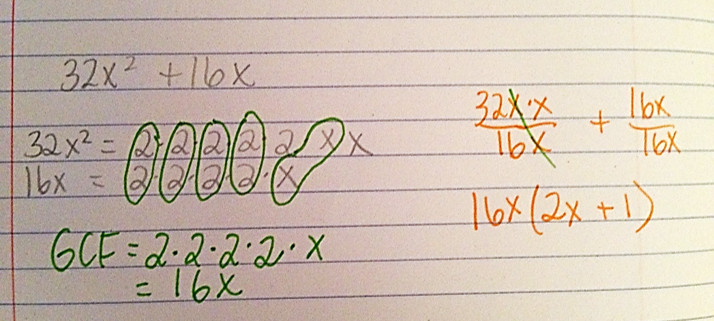
Have you read Math = Love's Candy Tax analogy for GCF?  I love it - I've used it every year since I read that blog post and this year, I made some cute notes to go with it.
Here is the gist of Sarah's Candy Tax Analogy, in my own words: When I take my kids trick-or-treating, I impose a candy tax on them for all the work I have to do as a parent. Because I'm fair, I take evenly from both my kids, but because I'm greedy, I take as much as I can. We do the first example and the kids are furious about this candy tax, because you take all of Susie's M&Ms.  I tell them, "That's her lesson to trick-or-treat harder next Halloween." Most of the students easily see that you cannot take any Milky Way or Pay Day since they don't both have them (not a shared term).

These doodle notes also seemed to help hook the idea in their brain, which is so handy when I refer back to GCF as Candy Tax as we continue factoring with the idea of "What do these terms have in common?" The kids also love have places to add pops of color and engage their right brain.


We practiced finding the GCF with this fun maze from Amazing Mathematics. I love a maze for the first time they practice something like this because it's much less intimidating for students to decide among possible GCFs than to write one on their own.

Then we filled out this table for practicing the connection between factoring and distributing. I'm not sure where I found this one, but it's great for connecting the idea of factor as the undoing of distribution.


For students who needed more scaffolding, we broke it down like this. And it was a great chance to refer back to those Laws of Exponents Notes.

The Day I Stopped Bringing Papers Home to Grade


One of my least favorite teacher tasks is grading papers. I try to get all my school work done at school (I have a one-year old and four-year old, so not much school work gets accomplished at home). Since I gave a short Polynomials Quiz to round out the week, I decided to bring the quizzes home to grade. Of course they sat in my school bag all weekend without ever being touched - I totally forgot they were even there. Monday morning, I'm unpacking my bag and I pull out an empty water bottle.


It's 7 am on a Monday morning, so my brain is not firing at 100% and I'm trying to remember if I put an empty water bottle in my bag. The bag didn't even feel wet. That's because I had 140 quizzes in my bag to soak it up!


I wanted to throw the whole soggy mess right into the trash can, but instead I put it down and went about teaching my first two classes. Luckily I had "pl-unch" on that Monday {planning and lunch together ;)} so with a two-hour break, I decided to lay the quizzes out to dry. They covered almost every surface in my room.


I decided to open the window to speed up the process and the wind caught it and blew it right off the hinge. So I also got to make an embarrassing phone call to the front office and basically tell them I am an idiot.


Then I walked around with my marker and started grading. Almost every paper had a least one dry corner where I could write the score and look how cool the papers look when you write on them wet. One student asked if I graded them with watercolor paints and another asked if I was so upset with the quiz grades that I threw them in the lake. #thingsteenagerssay.

Someone with a badge that said, "glazer" later showed up to fix my window, and give me a mini-lecture about not opening windows during wind advisories, which I totally deserved after he had to stand on a ladder next to my open second story window and screw a hinge back together.


Morale of the story - Stop bring papers home to grade!! :)


Low-Tech Student Response System


For the past two years, I've had clickers. I adore them. I could ask a multiple-choice question during instruction and receive instant feedback about what my students thought. I could even print fancy graphs to impress my administrators with my use of data-driven instruction. Then along came our district's mandatory update to Windows 10, which does not play nice with my amazing clickers. And I've been pouting even since. Each time I open a PowerPoint from last year, I see these beautiful multiple-choice questions and I angrily delete them or re-write them.

This week, I was introducing Polynomials, and I had great multiple-choice questions already formatted and ready to go. I decided to leave them in and just have students raise their hand for the correct answer. Lame, I know. 

We did these fun {free} notes to introduce the vocabulary and then it was time to practice with multiple choice, and I had a stroke of genius. I went to my supply cabinet and took out a stack of index card. I told students to write the letter A large with a marker. Then, turn it 90 degrees and write B (yes, upsidedown!). Then flip it and do the same with C and D. 


I posed the question, and they then held up their answer choice so that I could see it. 


I was able to quickly assess what students thought (just like my clickers used to allow me to do) and collect data that helps me drive instruction. I can't print out fancy-pants graph (one point clickers). BUT unlike the clickers, were I could only see a break-down of which students responded with each answer after the lesson, the index cards allow me a quick visual of who needs extra help (one point cards). Plus they actually WORK! (100 points cards) - and they will work with all future Windows updates as well ;) 


At the end of 1st period, I collected the cards and reused them throughout the day.  The students had much more fun with this than just raising their hand, and I saw less guessing/cheating/looking around. Another win for active engagement!

Here are the questions I used about classifying polynomials if you want to try them out. 
Related Posts Plugin for WordPress, Blogger...