Using the word wall

This week my students were trying to explain the relationship between the diagonals of a rectangle and square. They said things like - they are both 13.5 inches or they are the same thing, so I asked them to find a word on the word wall to describe the relationship. They quickly picked out congruent. It just so happened that I was being observed by a district specialist at the time and he said it was the first time he had actually seen a teacher use a word wall in instruction. 
At my school, the word wall is one item on a long list of required elements for dour classroom. Mine is completely student driven. They write the word and create a picture to go with it. Sometimes they choose to create a Frayer model or write a short definition. Sometimes I ask a student to add a word to the word wall and sometimes they initiate it themselves. When the students are involved, they take ownership and this word wall becomes a great resource to them.

Measurement Conversions


My students enjoyed this dominoes/ follow me activity for conversions. They were able to practice using the reference sheet and using different methods for converting measurements. 


VersaTiles

I am loving my new VersaTiles. They are truly as versatile as the name would suggest. I create a worksheet with 12 questions and an answer bank (I have made lessons on scientific notation, slope, reading graphs, angle relationships). Students use the tiles to match the problem number to their answer. For example the answer to Problem #9 is A so they move tile 9 to slot A. They are able to self correct when they get an answer that isn't on the sheet or when they get the same answer for two problems. At the end, they close the case and flip it over and reveal the picture. Again, they can easily self correct if their case does not make the correct pattern. These cases are well worth $13 and with the Versatiles answer sheet, you can create your own worksheets on any subject. I am currently using them for centers, and students are working individually, but they could easily be used in pairs or with group work.


Here is the link to the page to purchase them and the answer template.

Here is my Slope Versatiles Activity.


Scatter plots sort


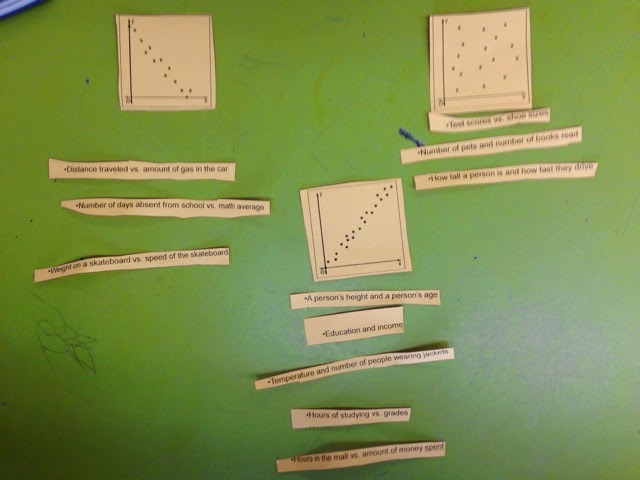
Today I tried this fun sorting activity for scatter plots: http://everybodyisageniusblog.blogspot.com/2012/08/scatter-plots-correlation.html?showComment=1395967903398&m=1 (PDF available for free)

When students have a graph to look at, they can easily see the correlation, but it's difficult when they only have the scenarios. We did a few examples together first and I helped them with the language. We talked about temperature vs sales of hot chocolate, ice cream, and ID badges (negative, positive, and no relationship). I made sure to model for them how to talk through these problems. There was some discussion about a few of them- the skaterboarders had a lot to say about the skating one. One student argued the jacket one was no relationship because students at our school wear jackets regardless of the weather to cover their uniforms. I love when students challenge answers and justify their ideas with reasoning - My students always amaze me!
Here is one students' ideas.

Then students used their phones to take pictures of their answers so they could easily compare them to their peers.

FACEing Math


I wish I could take credit for this idea, but all I did was find a link to it in Pinterest. It combines math and art. Students have to complete the face based on the answer they get for the first 12 questions. Here is an example


Then they color the picture based on the answers to the next 15 questions.


Here is a link to the freebie with Solving one step equations. I printed it and changed the equal signs to inequality signs so my 8th graders could practice solving inequalities.

This is a great assignment for centers because students can work independently or to leave with a sub. The Web site has options for all levels of math to purchase.

Gumball Competition

This is a fun way I found to create some healthy competition between my classes. We are working on Island 10 in Carnegie Mathia. Every time someone finishes a section, they get to add a gumball to their class's machine. The winner will get - GUM! I am also going to color code for sections. Right now they are all red for Section 1. Then they will get a blue one for Section 2. The kids love it so far!


Exponent Dominoes


I thought my introduction to exponents lesson would be a breeze, but students had a difficult time when parentheses and negative signs were involved. I saw lots of students with the same misconceptions, so I knew I needed an activity to help them differentiate between the two. I created Exponent Dominoes. The students loved this hands on activity. It led to great discussions like which of these match:


Before this activity, they could not see a difference between these expressions. They had to really understand what the parentheses mean to be able to correctly match the pairs. And they knew when they made a mistake because the end did not connect back to the beginning. Then they had to discuss where their mistake could be. Here is another one that really got to thinking. First a lot of them tried this:


One group tried this, but then decided since the two expressions were not equal that would not work. Nice try though - I may have to add a problem like that for next time.
 Ah yes, that's a match.
 My favorite part about this activity was it took only one piece of paper per group (I actually printed them on cardstock), and it led to very active engagement and great discussions. They all know the difference now between expressions inside parentheses and outside. Now on to Laws of Exponents ...
Here is the link to my Exponent Dominoes. Give it a try!

Related Posts Plugin for WordPress, Blogger...