

Showing posts with label cheap classroom ideas. Show all posts
Showing posts with label cheap classroom ideas. Show all posts
Scientific Notation Puzzle


Laws of Exponents Puzzle
I recently discovered Tarsia Puzzles and they are my new favorite go-to activity for practicing math problems. In this lesson, I used them to practicing power to a power, product rule, and quotient rule for exponents. The students had to correctly work out 30 problems to piece the puzzle together and they had way more fun practicing this way than a worksheet. I overheard some great discussions about the rules and misconceptions (which they can self-identify when they don't find the answer they are looking for).


Learn your multiplication facts


Scatter plots sort

Today I tried this fun sorting activity for scatter plots: http://everybodyisageniusblog.blogspot.com/2012/08/scatter-plots-correlation.html?showComment=1395967903398&m=1 (PDF available for free)
When students have a graph to look at, they can easily see the correlation, but it's difficult when they only have the scenarios. We did a few examples together first and I helped them with the language. We talked about temperature vs sales of hot chocolate, ice cream, and ID badges (negative, positive, and no relationship). I made sure to model for them how to talk through these problems. There was some discussion about a few of them- the skaterboarders had a lot to say about the skating one. One student argued the jacket one was no relationship because students at our school wear jackets regardless of the weather to cover their uniforms. I love when students challenge answers and justify their ideas with reasoning - My students always amaze me!
Here is one students' ideas.
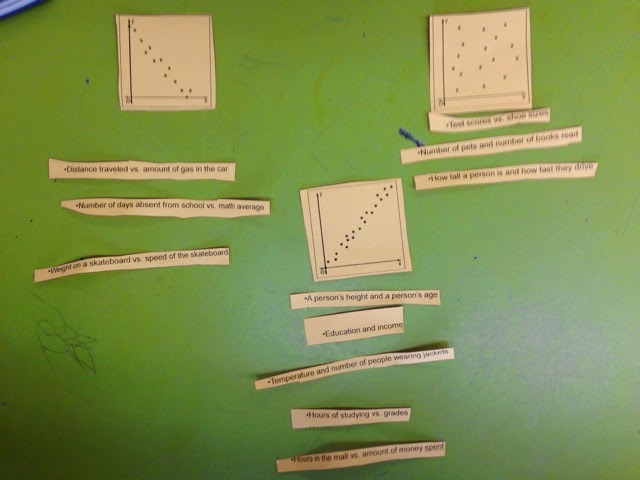
Then students used their phones to take pictures of their answers so they could easily compare them to their peers.
Gumball Competition


Exponent Dominoes

I thought my introduction to exponents lesson would be a breeze, but students had a difficult time when parentheses and negative signs were involved. I saw lots of students with the same misconceptions, so I knew I needed an activity to help them differentiate between the two. I created Exponent Dominoes. The students loved this hands on activity. It led to great discussions like which of these match:

Before this activity, they could not see a difference between these expressions. They had to really understand what the parentheses mean to be able to correctly match the pairs. And they knew when they made a mistake because the end did not connect back to the beginning. Then they had to discuss where their mistake could be. Here is another one that really got to thinking. First a lot of them tried this:

 Ah yes, that's a match.
 My favorite part about this activity was it took only one piece of paper per group (I actually printed them on cardstock), and it led to very active engagement and great discussions. They all know the difference now between expressions inside parentheses and outside. Now on to Laws of Exponents ...
Here is the link to my Exponent Dominoes. Give it a try!
One group tried this, but then decided since the two expressions were not equal that would not work. Nice try though - I may have to add a problem like that for next time.
Here is the link to my Exponent Dominoes. Give it a try!
Subscribe to:
Posts (Atom)
