Graphing Lines Coloring Activity #mathdollardeals


Summer is such a great time for reflecting on how to improve for the upcoming school year. I have been working on some new activities that my students love with concepts I think need more practice. My high school students love an excuse to get out the highlighters, markers, or even crayons to add a little color to their practicing. I created this coloring activity for students to practice matching equations of lines to their graphs - and it's on sale today for only $1 as part of Secondary Math Dollar Deals! The picture at the top has 12 equations in a mixture of slope-intercept, standard, and point-slope forms. Students then look at the graph and determine which equation it matches. They assign each group of graphs a color and then color the corresponding equations. They coloring is simple enough to provide a brain break (and an opportunity to self-check as they go), but not so time consuming that it takes away from the math. 

I'm teaming up with some awesome other TPT sellers to bring you $1 products every Tuesday all summer. It's a great chance to stock up for next year! 


"What if I don't have a favorite book?"

One of my end of the year activities this year was to complete a reflection. It asks students about themselves and the class. I was interested to read what advice my students had for my future students and what they took away from my Algebra class, but the reflection I came away with was much different.

Student 1: What if we don't have a favorite book?
Me: Well, you can put two favorites if you can't decide.
Student 1: No, I mean I don't have any favorite books.
Student 2: Me neither. I haven't read a book in years.
Student 3: I haven't read a book since I got a cell phone.
Student 4: I just put 'N/A' - doesn't that mean it doesn't apply to us?

I was so saddened by this realization that my students don't read ... at all. Since I'm their math teacher, I never really thought about it, but this activity brought it right to my radar. I started to walk around and look - about half my students actually had favorite books that are appropriate for their Lexile level and current enough that they have read them recently - and these students (generally speaking) did pretty well in my class this year. And the students who can't remember ever reading a book - or haven't - didn't do as well. Even though I teach math, I see a direct correlation between those who read and those who don't and their success in my class. Not only do the readers perform better in class, they are better spoken, and more persistent when it comes to finishing work. They usually score higher on standardized testing too.

This is not new information that kids don't try to read, but I think we are trying to correct it in the wrong way. We spent exorbitant amounts of money on intensive reading programs - in my 8 years, my school district has tried at least three. How about instead of another program, we put a book in their hand? How can we motivate teenagers to read?  I'm going to do my part to model good reading skills (when reading word problem aloud) and talk to the kids about what they are reading. I've heard the saying a million times -"every teacher is a reading teacher," and I'm going to make sure I'm doing my part to embrace it.

I'm also going to do everything in my power to foster my children's love for reading. My son, almost 4, loves pick out books for us to read and bedtime and will often fall asleep looking at books. My daughter, 1, currently chews on books, but must think they are delicious! I don't know when kids lose that passion (many told me it happens when they get a cell phone), but I am going to do my best to keep that fire ignited in my own kids - I know without a doubt, it is tied to academic success.

Function Notation Drag and Drop/ Open Middle


The state of Florida decided to up its assessment game two years ago - no longer are there many multiple choice questions on the EOC. One of the most challenging question types for students is drag and drop. (Every time I say this phrase someone asked me if I said "dragon drop," hence the silly graphic). This week Sarah Cater blogged about "Open Middle" questions, which are the same idea as these drag and drop questions. Math = Love: Evaluating Functions Puzzles - Open Middle Style


Here is a question I tried out with the kids this year.


My problem is easier than the one she created because I added the equal sign to narrow down their choices a bit, but I would love to scaffold to the more challenging problem she created. I have one-to one-laptops in my classroom, so we practiced on the computer on the Web site Nearpod. If you have technology available, you should absolutely try this Web site. I created this slide with the "fill in the blank" option. I love that students get practice manipulating the problem on the computer, just like the EOC. They also receive immediate feedback when they finish and I receive a report letting me know their score. You can see the question like my students did by navigating to the Web site and entering the PIN SMUBZ. This was a great test of students' perseverance and problem solving techniques - a lot of students thought it looked impossible at first but by the end they figured it out. 

If you don't have access to computers, try the paper version. I am attaching two versions one with the equal signs and one without (for more of a challenge). 

Coloring Activity {FLASH FREEBIE- May 20}

I hope you are enjoying your last few weeks of school (or maybe even your summer vacation!). I have just uploaded a new product I would love for you to try - so I am making it a FLASH FREEBIE!
I used this activity this week and my students really enjoyed it - the coloring is simple enough that it isn't too time consuming but allows for the "brain break" and extra engagement students need (especially this time of year). It's great for end-of-the-year review or even at the beginning of the next school year.  I will only be free today, so download it now!
Solve Multi-Step Equations Coloring Activity: Practice solving equations with Distributive Property, variables on both sides, combining like terms and all the properties of equality.


Please leave a rating on my product page and let me know what you think or how it worked in your classroom. Thanks for your support!
If you like it, check out my other Solving Equations Coloring Activities

*You missed the freebie, but you can still get this item for $2 from my TpT store. Thanks for your support!


Blocko!


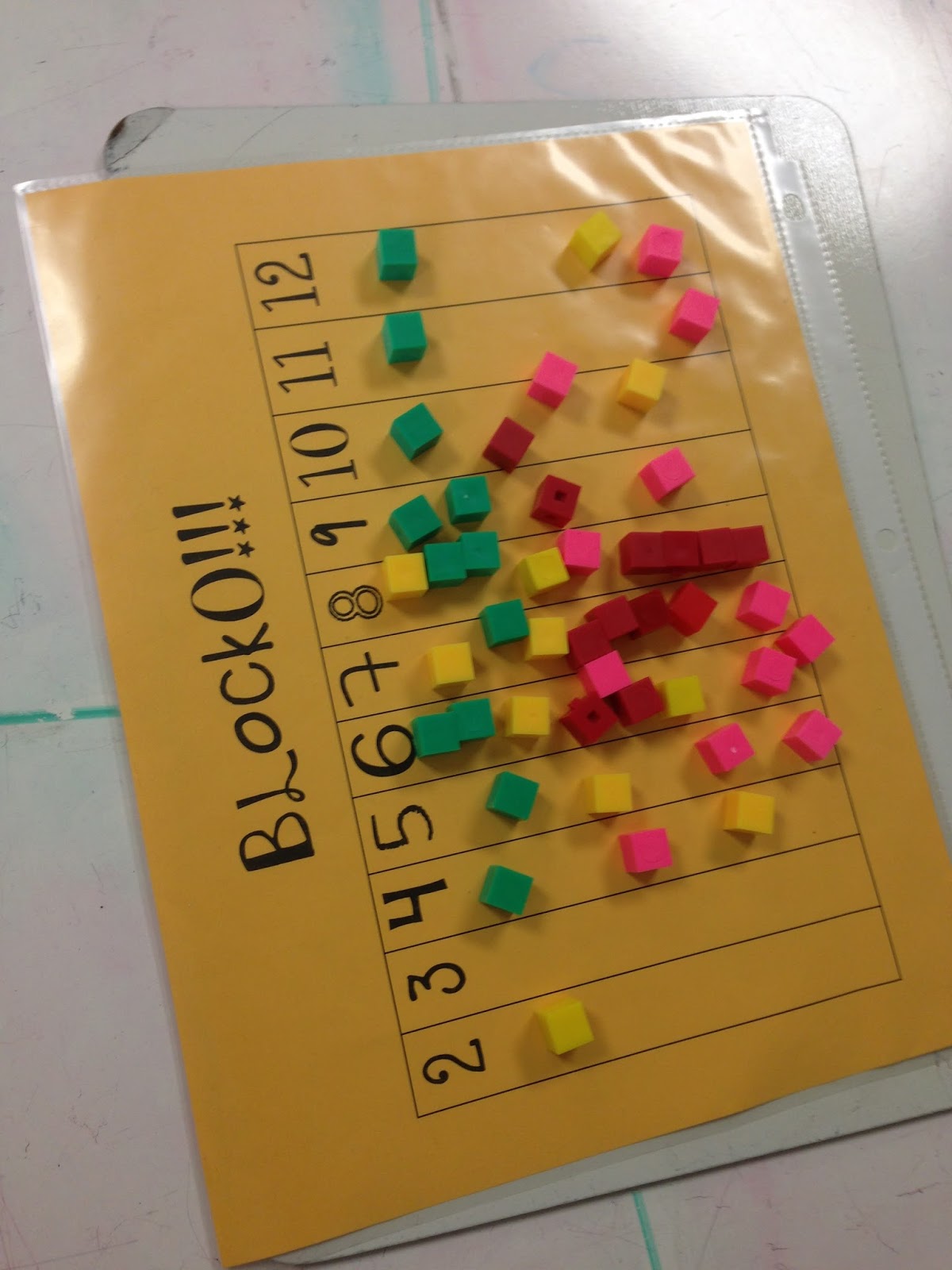
Probability has to be one of my favorite units. There was no much time for it built into the learning schedule, but after the End of Course Exam (given six weeks before the actual end of course!), my students needed something lighthearted and fun - and this was the perfect unit. I started looking for something fun but different than the traditional "roll the dice and collect tally marks" activity, and I came across this post from Sarah at "Math Equals Love" that linked me to "Beano," which is described as "probability-based Bingo using legumes and a pair of dice." A few weeks ago a student found some dried beans in a board game, attempted to eat one and complained about how gross it was: A. why would you ever put an identified object from a board game box into your mouth? B. what would make you think dried beans would taste good? Needless to say, I ruled out the "dried legume" part, but the actual concept for the game sounded fun. 

I had plenty of one centimeter cubes in a variety of colors, so I modified the game board with a fun font and a new name, and I decided to try it. To say this was a hit with my students is an understatement, they LOVED Blocko!
I never once mentioned that the game had anything to do with math. I just told them we were going to play a fun game and explained the rules:

In the first few rounds we played with only six blocks. I rolled "virtual dice" and called out the sum and the students removed their blocks when the sum was called. Several of my students didn't understand how this worked until they actually experienced a few rounds. Once they understood the rules, we played with all 12 blocks, and the winner won a Dum-Dum! I liked having groups of up to four students share one board (this is how the desks or arranged) because they can easily see how their strategy compares to others' strategies. Some of my students dropped their blocks onto the board to make it random, some spread them out onto each space every single time, and some students figured out which numbers had the highest probability of winning and won a lot of Dum-Dums. Everyone had fun!
We played this game in the last 10 minutes of class each day during our Probability Unit. During class on Thursday, I started collecting experimental data. I recorded the results of 10 games. During class today, we played the game again and I asked students if this data would influence how they placed their blocks. Some changed their strategy and some did not.  One student said, "It looks like a mountain if you turn your head to the side" (great observation!) One student even collected his own data to see if it matched the class' data.
Several students stopped putting blocks on 2 and 12 and I asked them why. Some pointed to the experimental data, but I probed them to explain it in terms of outcomes. We then filled out a chart of possible outcomes and translated that to a dot plot


Student used this data and the experimental data to answer questions about their strategy, observations during the game, and how their strategy changed. I used some of the questions from the original "Beano" materials and added some of my own.


As students developed a strategy, the games finished much quicker and they were more competitive. (Each game took about four minutes - two minutes for block placement and two minutes of dice rolling)  It was definitely a highly engaging game that I will look forward to each year. I hope your students like it too! Download materials here. 

Scientific Notation Puzzle


I recently discovered Tarsia Puzzles and they are my new favorite go-to activity for practicing math problems. In this lesson, I used them to practice Scientific Notation. This puzzle has problems with negative and positive exponents - several have the same coefficient so students really have to think about the function of the exponent. The students had to correctly work out 30 problems to piece the puzzle together and they had way more fun practicing this way than a worksheet. I overheard some great discussions about the rules and misconceptions (which they can self-identify when they don't find the answer they are looking for).

Here is the link to my Scientific Notation puzzle in TpT.

K'Nex Roller Coaster

For Christmas 1994, my brother and I got a K'Nex Roller Coaster set. My dad and I put the whole thing together in our living room (it took up a large part of the room). Now I have it in my classroom. The box was sitting in the corner building anticipation and now construction is underway. I teach two elective classes and one of the classes got to spend part of a period beginning to build.

I saw students using team building skills to work together and create a plan. I also saw them thinking spatially about the directions and how to connect pieces. I saw students who are usually not interested in anything math related take an interest in this activity. (I love when this happens).


 The directions are definitely not as clear as Lego directions, and allow for some interpretation. Students used ideas of symmetry to interpret the instructions. Day one of construction ended with a solid foundation and several jealous students who did not get to participate (only one of my six classes had the privilege so far), but I will definitely make more time for this in the FOUR weeks of school we have left. I sure how the coaster is complete by June 10, 2016!

Related Posts Plugin for WordPress, Blogger...