Math-y Door Decor


Last week is annual "Jacksonville Goes to College Week," so our guidance counselors challenged us to a door decorating contest. I typically write those off as, "Ain't nobody got time for that," but I had such luck with my Christmas Door Decorations that I wanted to give it a try. Just like when I did my Christmas door, I also did not want to lose any instruction time. Scaffolded Math and Science had the perfect solution for me - a Slope Tree, which fit right into our Linear Functions unit.


I gave each student a leaf and they found the slope between two points and then decorated it. It was a nice exit ticket for our class on slope. We put them all together to make a tree.


The idea for my "pun-ny" sign actually came a student who said, "If this is an exit ticket, can we 'leaf' when we finish it." I took that and said, "We are ready for college when we 'leaf' ACHS." Then one of my students added some color to it when she finished a test early.

I think it turned out great - a perfect fall decoration! And best of all - no instructional time was lost in the making of this awesome math-y door decor!
P.S. If you are looking for those awesome Welcome sign letters, they are from Math=Love here 

Hurricane Matthew: From Inside the Cone of Uncertainty

I grew up in the Midwest and left 10 years ago, trading the brutal winters for year-round sunshine. Although we have had a few near-hurricanes and tropical storms in my time as a Floridian, nothing has hit close to home like Hurricane Matthew. I live in Jacksonville, Florida about five miles from the coast, where we can afford a house but can also have our toes in the sand in 10 minutes flat, with my husband (also a teacher and a native Floridian) and our two children, 4 and 1.

On Monday, my husband texted me this picture and we talked vaguely about what would happen if the hurricane actually came near us in Jacksonville, but we didn't make any real plans.

On Tuesday, the clouds over my school looked a little ominous in the morning. The storm path hadn't changed much, so I stopped at the grocery store after school to stock up on water, snacks, and batteries and I filled my gas tank with a short wait.

By Wednesday, the mood around campus was that of uncertainly - Matthew had already torn through Haiti and Cuba and its strength was undeniable. The forecast path brought it closer to home. The students minds were filled with "What ifs" and I must have been asked if school would be canceled at least 50 times. Imagine teaching the day before a holiday break and multiply it by 10, that's how distracted these students' minds were, and mine was too. I was filled with uncertainty of what the weather would bring for me and my family and what decisions I should be making. I had a quiz scheduled (the end of the 1st quarter is nearing next week), but everyone was so preoccupied that I decided to make it open notes. I tried to make my lesson on slope as low-key as possible, we watched the Adventures of Slope Dude, took some notes and practiced with a Versatiles activity. I found that the kids needed the distraction as much as I did as the rain outside beat against the windows.
By the end of the last period of the day, the principal announced that school was canceled for Thursday and Friday and everyone, teachers included, needed to be off campus by 2:30. Leaving was so nerve-racking, not knowing what I would come back to. I unplugged everything, took a few pictures of my possessions, and headed out.
The few times I get to leave school at 2:30, I usually zip home and have free reign over all the stores. Today traffic was already building on the highways, and the line at the gas station stretched out onto the road with at least 10 cars waiting in each direction. I was happy to have already taken care of these stops earlier. When I got home, the news now projected this path:
Being a math teacher, I like making decisions based on odds and probability of events occurring, but it seemed like every time I looked at the news, the odds were changing. The meteorologists were giving the hurricane a 15 percent chance of making landfall in Jacksonville as a Category 4 storm. As I tried to go to bed that night - I began to truly understand the term "Cone of Uncertainty." Did it make sense for our family to leave town? Where would we go - we have family near Orlando and Tampa, but would the weather be just as bad there? And what would traffic be like as we went there and returned home after the storm? What if the storm did significant damage to our house and no one was there to protect it because we had left? What is the storm did significant damage to our house and we were there with our two babies? What would it be like to have two small children without power in our house? Would I be able to remain calm if a true category 4 hurricane came through? 

I decided to pack a bag with clothes for everyone for five days, snacks and water, and all my hard drives of family photos, and sleep on the decision. I woke to find this on my phone: 
The uncertainty was too much, and I knew staying and waiting would make me a nervous wreck for the next few days, which I knew would have a 100% chance of negatively impacting my parenting skills. My husband decided to stay back and board up the house and deal with any damages or issues, and I buckled the kids in their car seats and hit the road for Grandma's house. My mother-in-law lives just south of Orlando and their weather forecast called for 35 mph winds and rain, which sounded much better than the 100 mph winds that could be possible in Jacksonville. I decided that the worst-case scenario of evacuating would be a traffic jam, and the worse-case scenario of staying was being huddled into the bathroom with my two little ones as a tree crashed through our roof. 

My husband weathered the storm at home without ever losing power. The wind was fierce and the rain was relentless, but our house escaped unscathed, except for some downed tree branches and mud puddles in our backyard. Many of my friends and neighbors were not so lucky.

Today my husband asked me, "If you had this to do over again, would you do it the same?" Again comes that "Cone of Uncertainty," did I make the right decision? Did I over-react by leaving? Was it overkill to board up our windows?  As a math teacher, my brain is trained to be analytical, but Mother Nature cannot be tied down with logic and reason. I do know that as this storm shifted countless times with different trajectories, I was happy to be watching from a safe distance away. 

How a hole puncher saved the day: Proving Lines Parallel Proof Activity

Even in the 7th week of school, Geometry proofs still strike fear into my little freshmen. For today's lesson on proving lines parallel, I knew I wanted them to do proofs. I found this great cut and paste activity from Amazing Mathematics. I chose to print the version that has the statements filled in and students only have to come up with the reasons for each step. By the time we get to triangle congruence, they will be writing both sides, but I was OK with giving them the outline today.

We reviewed all the theorems and converses and theorems and did a few examples together in their interactive notebooks, and then I set them lose on the proofs. I have my students grouped in threes, which is plenty of brain power to figure out these proofs. I gave each group a strip of paper and had them write the numbers 1-6 on it. Each group started with a proof (I only used 1-4 in the first round because they get increasingly more difficult). They worked together to correctly place the reasons in the proof. When the group agreed, they called me over for a check.


If it was right, I took my blue marker and scribbled off the number of the proof they finished. Then I saw a student look the other blue markers in my supply box with a gleam in his eye. And I realized with this system, there is no way I would be able to keep them from cheating. I changed the scribble to my initials, and then I had a better idea... I dug into the depths of my desk drawer and I got out my single hole puncher and punched a hole over the number when they completed it. The students LOVED it! It's amazing how something so simple totally changes the game. Then they wanted to use the hole puncher - and they would fight over whose turn it was to make the punch. The click of the puncher and the creation of the hole was as satisfying as correctly completing the proof. After I (or they) punched the number, they scrambled up the pieces and took it to the middle table and exchanged it for another proof. They kept doing this until they finished all six proofs.


Typically telling students they would be completing six Geometry proofs to prove lines parallel would be met with moans and groans, but my students were very engaged and motivated to finish the problems. I definitely see my hole puncher making future appearances in class!


Next they are going to try out this Proving Lines Parallel Crossword Puzzle. The outline of the proof is still there, but they have to come up with some missing statements and reasons. They still get the self-checking benefit of the crossword puzzle though.


Connecting Inequalities to Domain and Range

There are some concepts that I know I do a great job of explaining and others that I struggle with. At the end of the school year, I made a list of things I want to do better, and a few topics from the functions unit were on there: domain and range, using the term f(x), understanding linear translations, and focusing on parent functions. As we finished up the unit on Inequalities, I knew that I wanted to start the functions unit with domain and range so that I can refer to domain and range throughout the entire unit. As I was preparing my notes, I had a "A-Ha" moment that I could present it as a compound inequality. I loved the lesson I found on compound inequalities and my students had a good understanding of writing and graphing them.

First we talked about the vocabulary for domain and range. I told them I remember that range is for y because both the g in range and y are descender, which means they dip below the writing line. I told them to pick two colored markers and color-code the words domain and range everywhere they saw them on the page. (I also made a point to tell them to pick two colors that will look different on salmon colored paper, after a student picked red and pink and couldn't tell the difference.)

The first two examples are pretty straight forward. It's when we get to the graph that things get fun. I tried the method of making the smallest possible box around the function, but several students got confused, so I changed it to finding the farthest left and right point and drawing a line to the x-axis. I then shaded the x-axis between these two values and asked, "Who can write an inequality that describes this?" I told them because this was tricky, I was offering a "Dum-Dum" to anyone will to take a risk and try it. I don't break out the candy often - it's week 7 and this was the first candy-sighting in my room, but I knew this concept was difficult. Students were fighting over trying the inequality for y.

Then I presented these three problems and asked students to talk about how they were similar and different. They pointed out that the first graph has only points, the next has endpoints, and the last has arrows, meaning it continues forever. I did the domain for the first problem and had students come up to do the range and domain and range for the middle function. For the last one, we shaded the whole x-axis and I reminded them about problems where every number is a solution and connected that idea to the domain of all real numbers. Then I asked for the maximum, which students identified at 4, so I shaded the whole y-axis below 4. Students easily saw that as y<4. Yay!

Next it was time for some scaffolded practice. I LOVE this sorting activity. I kept the cards together (they print 4 per page) and cut apart the slips for domain and range. I find that sometimes less moving pieces helps students to focus. I loved the variety of  these 20 problems and the great conversations I overheard. Students struggled most with the circles and the line, but these led to more great discussions and opportunities for me to relate them to problems they have seen. By week 7, my students are learning that I will not give them the answer, but I will ask them questions to help them come to the answer on their own [Give a man a fish, and he eats for a day. Teach a man to fish, and he will eat for a lifetime.]

As they finished, I gave them pennant problems to practice on their own. On Wednesday, we followed an early release schedule, so each student did one problem. My students on Thursday did three each. Following the gradual release, this was a great way to end because students had to come up with the domain and range on their own. And they could! They learned so much, we ran out of room on the yarn! On to more functions fun next week!

Inequalities Ideas


My students had such a good handle on equations that Inequalities was pretty much a breeze. I started with the discussion of the prefix in- , which most of my students could tell me meant not, and how these problems would not have an equals sign. I talked about how they would have a whole solution set instead.


We started with this foldable, a freebie in my TPT store! It was easily the most referenced notes in this unit. I loved watching the students flip back and look at it as we worked through the unit. We did a few notes about how to write a inequality from a number line and vice versa. Several students pointed out the trick about the inequality being an arrow showing where to shade, and I asked then if there was a difference between x>1 and 1>x, since both arrows points the same way. I told them that instead of memorizing a trick, they should think about which direction would make the inequality true or test a number to figure out how to shade. Nix the Tricks, boys and girls, and make math make sense! Every since time I graphed an inequality (and it was a lot over five sections of Algebra for four class periods), I talked through how to figure out which direction to shade an never once did I mention this trick, so hopefully they forgot it ;)

Day 2 we started off with some simple inequalities word problems - I love starting with word problems, and I have found that this year my students are not so afraid of them because we have been tackling word problems since day one. We also have fun using highlighters to pick out key words from the problems. I then introduced the key difference between inequalities and equations - if you divide by a negative, you flip the inequality symbol. We talked about why and then did some examples in "To Flip or Not To Flip." I liked these examples because my students often overgeneralize and just assume that if the problem involves a negative number, they flip the sign. These examples helped them to see when to flip and when not to flip.


For classwork, we did this matching activity by Amazing Mathematics that I loved! You start with a word problem and then match it to the inequality (I saw a lot of students using their foldables for this), then solve it, then graph it.

The students were a little overwhelmed at first, but they worked together to conquer. I told them everyone doesn't have to work out every problem, but you all have to agree on the work. This lead to some great discussions when someone had an answer that a group member wanted. This was a great activity with awesome discussions, teamwork and inequalities practice.

The next day we took on some Multi-Step Inequalities, including special solutions. Students practiced with this Tarsia Puzzle.

I love these collaborative puzzles for practice, especially for something like this where students can easily make little errors. When they don't find their answer, they are forced to re-examine their work or possibly the work of their peer - I hear such great discussions from this, that I never hear when students are working on a worksheet or textbook problems.

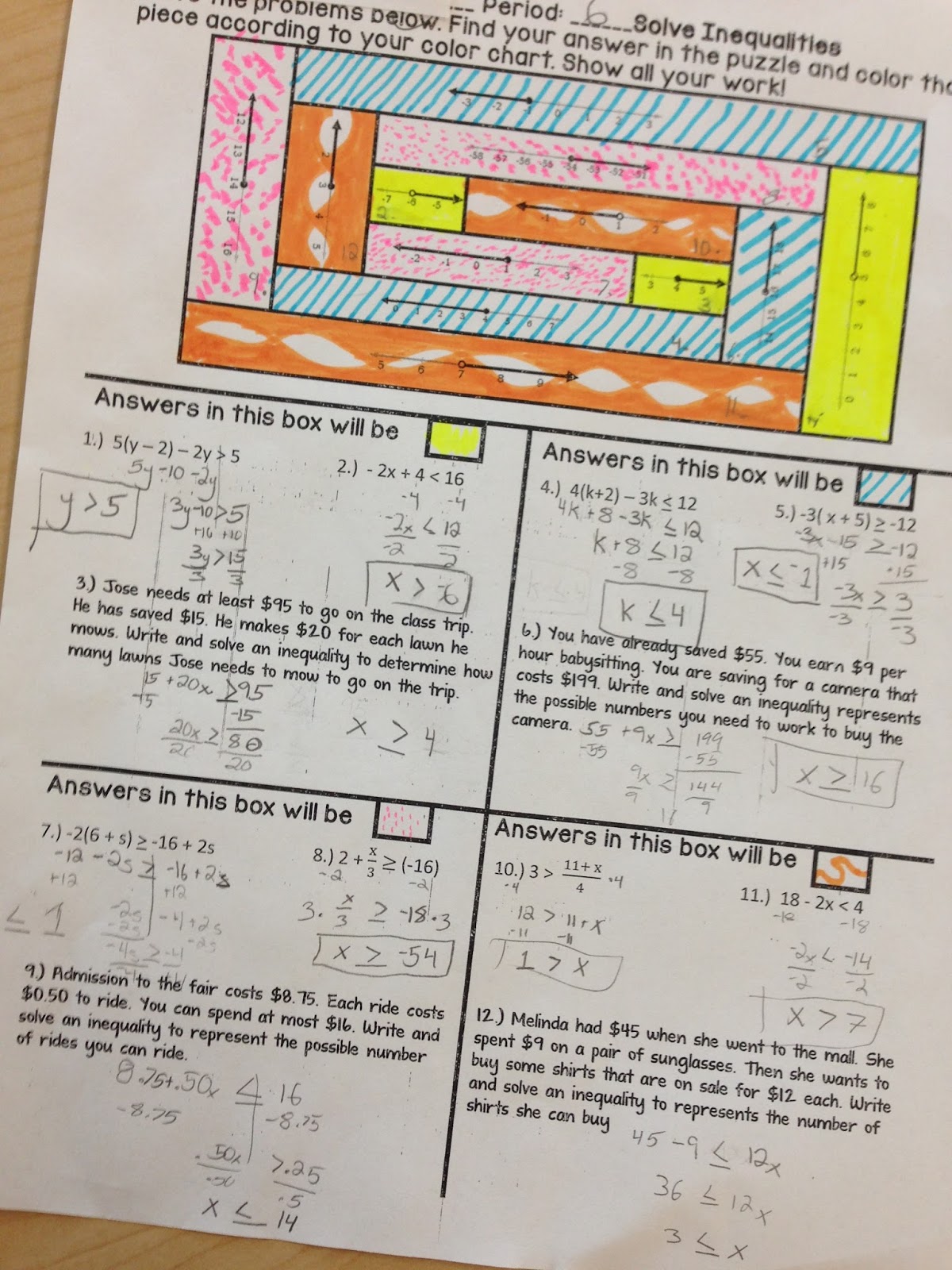
When they finished, they started on this coloring activity that they finished up for homework. It also helped them to study for their quiz, which was today. From what I have graded so far, they did really well. After the quiz, I had my best lesson yet on compound inequalities. I really wanted to focus on preparing them for writing compound inequalities for domain and range. We did this problem, from Algebra Nation, with an answer bank. Giving students an answer bank really helped them to break down this task and think about how to represent situations with compound inequalities.

Then I did this activity, which may be one of my favorite things yet. They graph compound inequalities from parking signs based on when cars CAN park.
 I loved how this made a concept that is usually tricky for my students into something relevant and fun. Speaking of fun, on to "fun"-ctions next! 

How my students discovered the distance formula

My focus in geometry has been on conceptual understanding, so in introducing distance formula, I wanted to make sure students understood the why. It took me two days, but my students have really grasped this concept, so I am very proud of them.

I started with a review of Pythagorean Theorem. We reviewed the puzzle and did some practice with this Tarsia puzzle {a freebie in my TpT store!}

My students did these pennants from Scaffolded Math and Science, which have awesome questions to get kids thinking about Pythagorean Theorem (and they look great as classroom decor). I love the questions that start my giving students the area of the right triangle a side length and ask them to work backwards to the side lengths. I also love that this student made Pythagoras a red head - like me :)


Once we had the mechanics of the Pythagorean Theorem ironed out, we put it onto a coordinate plane. We graphed two points and I asked students if they could see a way to apply the Pythagorean Theorem. We had a great discussion about how it didn't matter if you drew the right triangle above or below the segment. One student even pointed out, "You are always going to be missing the hypotenuse because you can't count the diagonal distance." (Which I was SO excited to hear a student articulate. I can't tell you how many times I have seen students try to count diagonally across the graph.) We did two examples in their INBs and then I gave them this Distance Formula Maze. I printed them one 1/4 of a page and attached graphs to the sheet. I told them to complete the first five problems using Pythagorean Theorem and then stop.


As they worked, I asked them to think about whether they could do this problem without a graph and what that would look like. I also told them I would give a Dum-Dum to any really good answers, so that got students extra motivated. One student said, "Draw a graph!" I told him that would be a great strategy on the EOC, but I wanted them to try it without graphing anything, so they went back to thinking.

One student called me over and said, "Couldn't you just find the difference between the y-values and x-values in your ordered pairs and then use those numbers to do Pythagorean Theorem?" I asked her to prove this would work with an example she already did, so she looked a problem one, where she found the distance between (4,7) and (8,-5). She said, "Well 7 - (-5) is 12, so ... oh look, that's the same as the length of the leg. And 8-4 is 4 - so I think that would work." Then another student called me over and said, "This reminds me of learning about slope in Algebra class and this formula  y2-y1 / x2-x1. Expect you wouldn't want to divide them at the end." I was so excited  - here were my students coming up with ideas and connecting to prior knowledge all on their own. We flushed out these ideas with a group discussion and came up with the distance formula. They saw the connection between Pythagorean Theorem and the Distance Formula and my textbook has this cool graphic that helps really make that connection.


Then we did some examples and I sent them back to their maze. I told them to try our new formula for the next five and then they could finish any way they wanted.

As students practiced, they started to favor one or the other. A few clever students came up with a hybrid of their own. One student was so proud he called me over and asked if it was OK for him to make up his own distance formula. I was intrigued, so he demonstrated with the points (1, -4) and (7, -1). He drew a table to help him find the distance between the x and y-values and then plugged those numbers into Pythagorean Theorem. Talk about taking ownership of your learning!

Our next lesson was midpoint, which I used my fan lesson that I blogged about here. Again, the students understood what they were doing. Today, I gave them this mini quiz with a tough Check All That Apply problem, and they nailed it! Discovery learning and conceptual understanding
for the win!

Open House: Why I made the PARENTS do math


One of the LONGEST days of the school year is Open House. School is from 7:05-2:25 and then Open House is from 5:30-7:45. The window between allows for just enough time to leave campus and get caught in rush hour traffic or stay on campus and go stir crazy!


Our parents follow their students schedule to "get a glimpse of their students' day," with the bell ringing every 10 minutes. In years past, I have talked about the syllabus and the course, but this year I started to think about how I really wanted the parents to know what it would be like to sit in my Algebra 1 class - so I made them do math!


We do A LOT of puzzles in my class - it's my favorite practice structure. So far this year we have done Solving Equations with Symbols (on the first day of school) and Distribute and Combine Like Terms to Solve Equations. Most of my parents drag their teenagers along  bring their child with them, so I greeted the child at the door and asked them to explain the puzzle to their parents. Just like in class, how I have students explain things to their peers. I had the picture of the finished puzzle on the board. Some parents were reluctant to start, but so are some of my students, and with a little encouragement, they saw that they can do it. The puzzle is a simple one that reviews multiplication tables, so it's not math that was too complicated, but engaging in this activity allowed them to truly experience my class as a student.

The parents had fun, they talked with their children and other parents and worked together (just like their students). They celebrated when they completed the puzzle (just like we do in class), and they made and corrected errors (do you spy one in the pic above?). Most importantly, the parents saw that math - at least in my classroom - isn't something to be scared of. 

After they finished the puzzle (it took less than four minutes), I had plenty of time to review the important information about my class - my contact information, the dates of the state EOC, my homework policy, tutoring schedule, etc. Students who came with their parents earned a free homework pass!


At the end of the night, my feet and legs ached, and I left knowing that I would be right back in that classroom in less than 11 hours. I had two parents ask if they could take a copy of the puzzle home to do again with their student or younger student, three parents tell me their students have told them that I am the best math teacher they have ever had, and I had classes full of engaged parents, who maybe after their 10 minutes in my class, are a little less afraid of math.

Related Posts Plugin for WordPress, Blogger...